 Add to Chrome
 Add to Firefox
 Add to Edge
AdaCodec: A Predictive Visual Code for Video MLLMs
Jun 01, 2026
Video is temporally redundant: adjacent frames usually share most objects, background, and layout. Yet existing video multimodal large language models (video MLLMs) usually encode each sampled frame as an independent RGB image, causing visual tokens to repeat content already present in earlier frames. This suggests a more direct video interface: send a full reference frame only when the scene cannot be predicted well from prior context, and otherwise transmit a compact description of inter-frame changes. We call this interface a \emph{predictive visual code}, and instantiate it for video MLLMs as \textbf{AdaCodec}. AdaCodec spends full visual tokens on a reference frame only when its conditional predictive cost is high; otherwise, it encodes inter-frame changes, including motion and prediction residuals, as compact P-tokens. Across all eleven benchmarks, AdaCodec improves over the Qwen3-VL-8B per-frame RGB baseline at a matched visual-token budget. Even at $1/7$ the budget, AdaCodec with 32k tokens surpasses the 224k baseline on all long-video benchmarks; on five general-video benchmarks, it raises the average score while substantially cutting time-to-first-token from 9.26s to 1.62s.

LVOmniBench: Pioneering Long Audio-Video Understanding Evaluation for Omnimodal LLMs
Mar 19, 2026Recent advancements in omnimodal large language models (OmniLLMs) have significantly improved the comprehension of audio and video inputs. However, current evaluations primarily focus on short audio and video clips ranging from 10 seconds to 5 minutes, failing to reflect the demands of real-world applications, where videos typically run for tens of minutes. To address this critical gap, we introduce LVOmniBench, a new benchmark designed specifically for the cross-modal comprehension of long-form audio and video. This dataset comprises high-quality videos sourced from open platforms that feature rich audio-visual dynamics. Through rigorous manual selection and annotation, LVOmniBench comprises 275 videos, ranging in duration from 10 to 90 minutes, and 1,014 question-answer (QA) pairs. LVOmniBench aims to rigorously evaluate the capabilities of OmniLLMs across domains, including long-term memory, temporal localization, fine-grained understanding, and multimodal perception. Our extensive evaluation reveals that current OmniLLMs encounter significant challenges when processing extended audio-visual inputs. Open-source models generally achieve accuracies below 35%, whereas the Gemini 3 Pro reaches a peak accuracy of approximately 65%. We anticipate that this dataset, along with our empirical findings, will stimulate further research and the development of advanced models capable of resolving complex cross-modal understanding problems within long-form audio-visual contexts.
OmniZip: Audio-Guided Dynamic Token Compression for Fast Omnimodal Large Language Models
Nov 18, 2025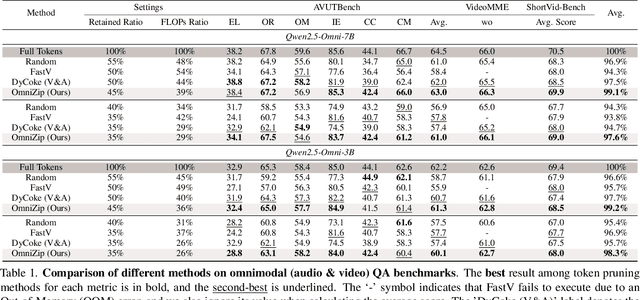
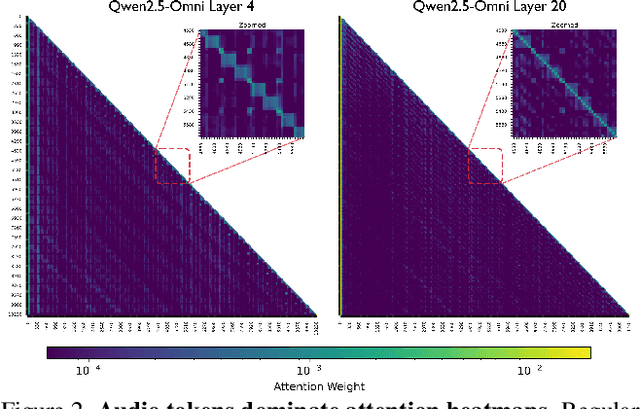
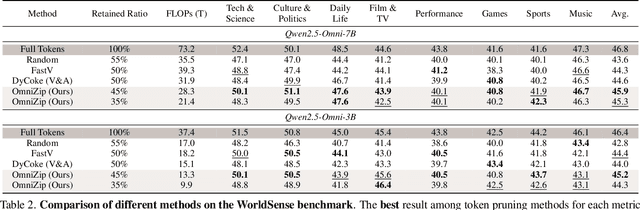
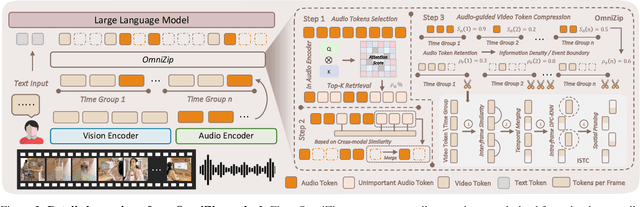
Omnimodal large language models (OmniLLMs) have attracted increasing research attention of late towards unified audio-video understanding, wherein processing audio-video token sequences creates a significant computational bottleneck, however. Existing token compression methods have yet to accommodate this emerging need of jointly compressing multimodal tokens. To bridge this gap, we present OmniZip, a training-free, audio-guided audio-visual token-compression framework that optimizes multimodal token representation and accelerates inference. Specifically, OmniZip first identifies salient audio tokens, then computes an audio retention score for each time group to capture information density, thereby dynamically guiding video token pruning and preserving cues from audio anchors enhanced by cross-modal similarity. For each time window, OmniZip compresses the video tokens using an interleaved spatio-temporal scheme. Extensive empirical results demonstrate the merits of OmniZip - it achieves 3.42X inference speedup and 1.4X memory reduction over other top-performing counterparts, while maintaining performance with no training.
When Tokens Talk Too Much: A Survey of Multimodal Long-Context Token Compression across Images, Videos, and Audios
Jul 27, 2025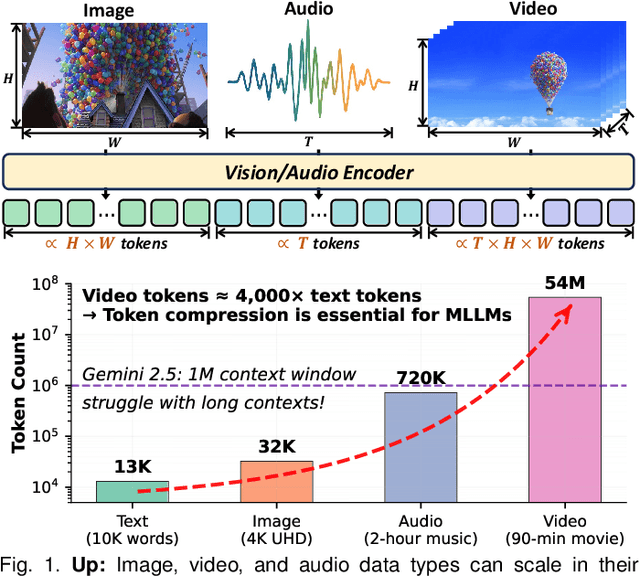
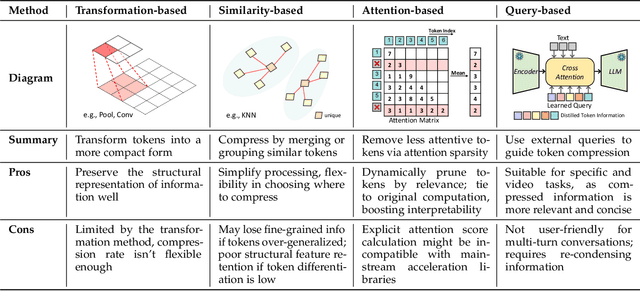
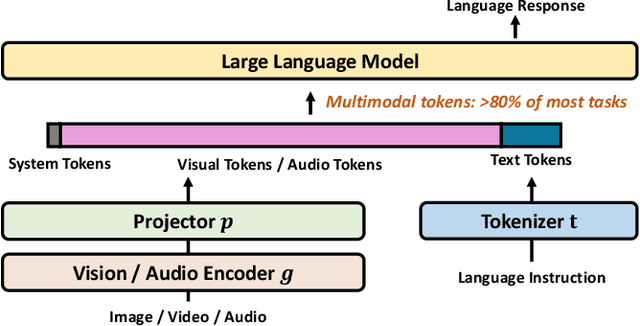
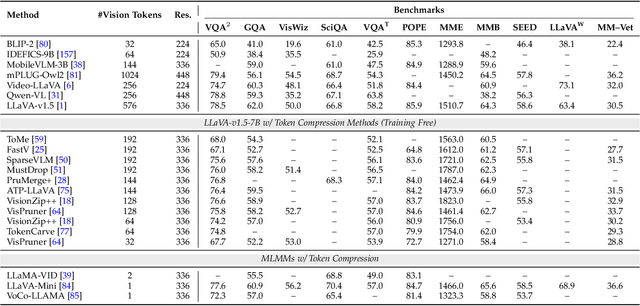
Multimodal large language models (MLLMs) have made remarkable strides, largely driven by their ability to process increasingly long and complex contexts, such as high-resolution images, extended video sequences, and lengthy audio input. While this ability significantly enhances MLLM capabilities, it introduces substantial computational challenges, primarily due to the quadratic complexity of self-attention mechanisms with numerous input tokens. To mitigate these bottlenecks, token compression has emerged as an auspicious and critical approach, efficiently reducing the number of tokens during both training and inference. In this paper, we present the first systematic survey and synthesis of the burgeoning field of multimodal long context token compression. Recognizing that effective compression strategies are deeply tied to the unique characteristics and redundancies of each modality, we categorize existing approaches by their primary data focus, enabling researchers to quickly access and learn methods tailored to their specific area of interest: (1) image-centric compression, which addresses spatial redundancy in visual data; (2) video-centric compression, which tackles spatio-temporal redundancy in dynamic sequences; and (3) audio-centric compression, which handles temporal and spectral redundancy in acoustic signals. Beyond this modality-driven categorization, we further dissect methods based on their underlying mechanisms, including transformation-based, similarity-based, attention-based, and query-based approaches. By providing a comprehensive and structured overview, this survey aims to consolidate current progress, identify key challenges, and inspire future research directions in this rapidly evolving domain. We also maintain a public repository to continuously track and update the latest advances in this promising area.
HoliTom: Holistic Token Merging for Fast Video Large Language Models
May 28, 2025Video large language models (video LLMs) excel at video comprehension but face significant computational inefficiency due to redundant video tokens. Existing token pruning methods offer solutions. However, approaches operating within the LLM (inner-LLM pruning), such as FastV, incur intrinsic computational overhead in shallow layers. In contrast, methods performing token pruning before the LLM (outer-LLM pruning) primarily address spatial redundancy within individual frames or limited temporal windows, neglecting the crucial global temporal dynamics and correlations across longer video sequences. This leads to sub-optimal spatio-temporal reduction and does not leverage video compressibility fully. Crucially, the synergistic potential and mutual influence of combining these strategies remain unexplored. To further reduce redundancy, we introduce HoliTom, a novel training-free holistic token merging framework. HoliTom employs outer-LLM pruning through global redundancy-aware temporal segmentation, followed by spatial-temporal merging to reduce visual tokens by over 90%, significantly alleviating the LLM's computational burden. Complementing this, we introduce a robust inner-LLM token similarity-based merging approach, designed for superior performance and compatibility with outer-LLM pruning. Evaluations demonstrate our method's promising efficiency-performance trade-off on LLaVA-OneVision-7B, reducing computational costs to 6.9% of FLOPs while maintaining 99.1% of the original performance. Furthermore, we achieve a 2.28x reduction in Time-To-First-Token (TTFT) and a 1.32x acceleration in decoding throughput, highlighting the practical benefits of our integrated pruning approach for efficient video LLMs inference.